This article was originally published in Consumer Goods Technology (CGT).
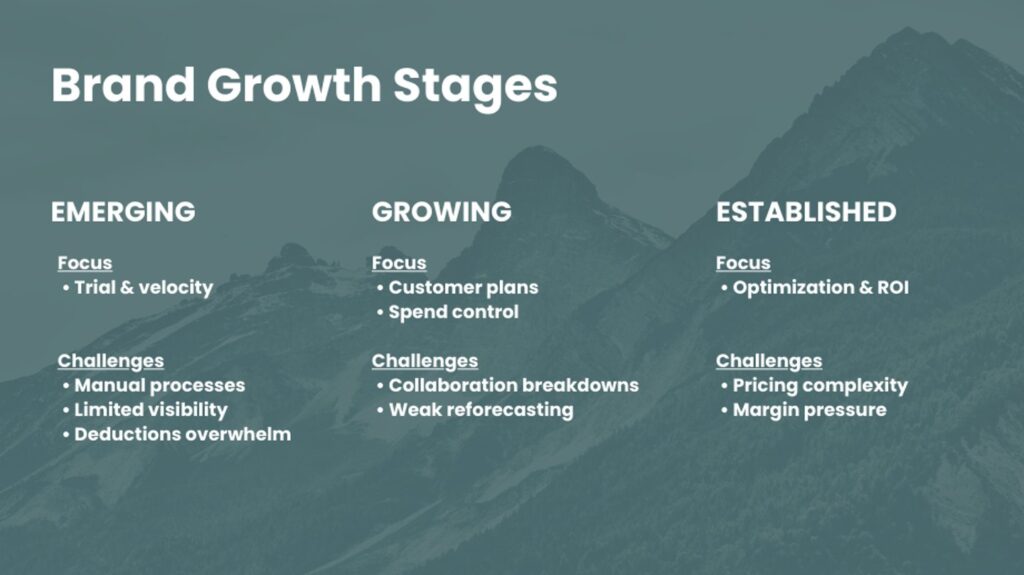
Every CPG/FMCG brand starts with the same north star: trial and velocity. In the earliest stages, success is measured by winning distribution, getting on-shelf and proving that shoppers will buy again. The operating model is lean. Decisions are fast. This is the first “mountain” to climb. Spreadsheets, emails and a handful of trusted people can carry the business surprisingly far.
But growth changes everything. The next summit is higher, and there are more obstacles in the way of reaching it.
As a brand adds products, customers, channels, promotions and people, the challenges shift. Collaboration becomes harder. Trade spending accelerates. Deductions pile up. Maintaining profitability requires more rigor, more visibility and better coordination between sales, finance and operations. This is where we see brands mature into new processes — and where systems begin to play a critical role.
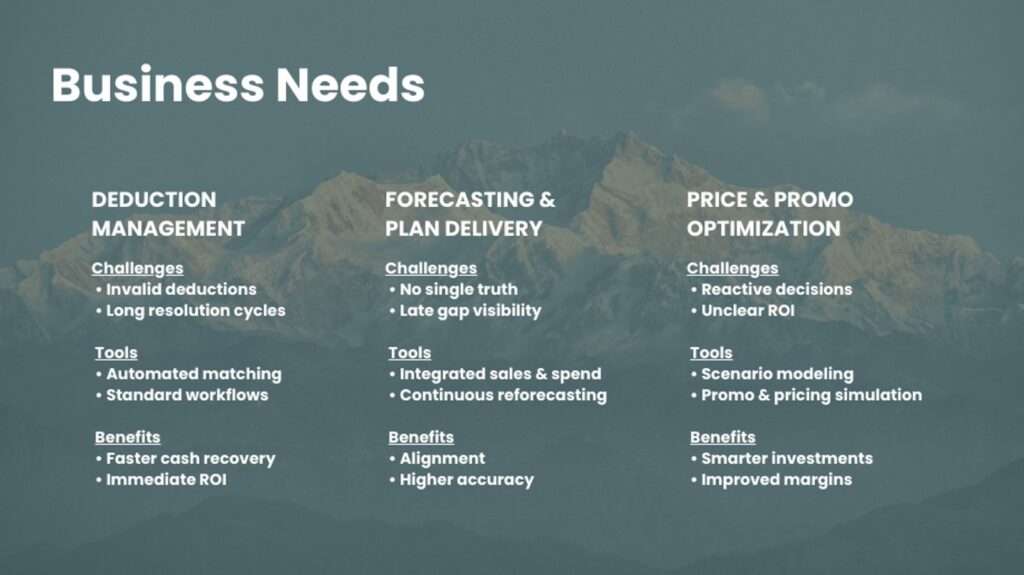
For many SMB and emerging brands, the first peak to climb is deduction management. Deductions often start as an afterthought — then they overwhelm and become an operational breaking point. As sales grow, brands encounter:
The root causes are familiar: manual processes, limited visibility into what was planned vs. what was executed and reliance on tribal knowledge.
For this climb, tools and technology make an immediate impact by connecting deductions back to planned promotions, validating accuracy and standardizing workflows. Automated matching, better documentation and clear ownership dramatically improve speed, accuracy and cash recovery — often delivering ROI faster than any other initiative.
If deductions are under control, the focus naturally changes to a more challenging hill to climb: managing customer performance against annual targets. As brands grow, leadership asks new questions:
This evolution usually coincides with more people being involved — sales leadership, finance, account managers, revenue management teams and field sales. The challenge is no longer just data availability; it’s accuracy, alignment and gap management.
Technology helps by creating a single, structured view of customer sales, trade spend, net sales and profitability, updated continuously through reforecasts. Instead of reacting late in the year, teams can see issues earlier and take corrective action with confidence.
When brands have a handle on forecasting and delivery, they move beyond control and visibility to optimization. This is where questions shift from “Did we hit the number?” to “Could we have done better?” Brands look to optimize:
Scenario planning is essential. With the right tools, teams can test alternatives — price changes, promotional mixes or investment shifts — before committing in-market. This improves both decision speed and decision quality, especially in volatile environments where assumptions change quickly.
Across our client base, we typically see the “climb team” grow as these new mountains are climbed:
Common triggers that influence stage change include adding customers, moving into new regions, expanding product portfolio or experiencing margin pressure that spreadsheets can no longer explain.
Put simply: user experience and intelligence. AI makes it faster and easier to complete tasks, reducing overhead that users don’t like … as long as you have the underlying capabilities to which you can apply agents and other AI technology. AI also means working smarter. Suggestions, predictions and insights. We refer to these two dimensions as “orchestration” and “optimization.”
Like a climber on a mountain, there are a multitude of paths that could be taken and decisions that need to be made. Here are four suggestions to plan your ascent strategy:
Growth changes the game. The right processes — and the right system — make sure you’re ready for the mountain you’re going to encounter next.