
Optimizing promotional spending in retail consumer packaged goods starts with a counterintuitive truth: the problem is not that CPG/FMCG brands spend too much on trade promotions, it is that they spend it in the wrong places.
Research from McKinsey & Company shows that 72% of US trade promotions fail to generate a positive return on investment. Yet most CPG brands continue running the same promotional programs year after year, because they lack the data infrastructure to identify which specific promotions, mechanics, and retail customers are generating returns and which are destroying margin.
UpClear’s Blue RGM provides an integrated TPM and TPO platform that helps CPG/FMCG brands systematically shift promotional spending from a loss-making activity to a high-return investment. Companies including Danone, Utz, Vita Coco, Warburtons, Hovis, and Twinings use the platform to unlock the consistent measurement, scenario simulation, and planning governance tools they need to reach their revenue goals. Brands using Blue RGM achieve a 5-15% improvement in promotional ROI within the first full planning cycle.
The foundation of promotional spending optimization is a rigorous historical audit before the next annual operating planning (AOP) cycle begins. For every promotion in the prior 12–24 months, calculate: total sell-out volume, baseline volume, incremental volume, incremental gross profit, total trade investment, and ROI.
Next, rank all promotions from highest to lowest ROI. This ranking reveals the patterns that portfolio-level averages hide:
A common cause of suboptimal promotional spending in CPG/FMCG is Same As Last Year (SALY) planning or using last year’s promotional calendar as the default starting point without interrogating it. SALY planning perpetuates underperforming promotions, prevents budget reallocation to higher-performing alternatives, and systematically repeats the same ROI mistakes cycle after cycle.
Breaking this cycle requires treating the prior year’s promotional data as evidence, not as a template. The historical audit from Step 1 produces the evidence. The Compass module in Blue RGM by UpClear provides the mechanism. HQ teams can embed minimum ROI thresholds and spending guardrails in the account planning workflow, preventing account managers from replicating promotions that failed to meet the ROI floor in prior periods without explicit exception approval from Finance and Revenue Management. This governance structure, enforced automatically within Blue RGM rather than documented in a PDF no one reads, is the single most effective structural change CPG brands can make to improve promotional spending efficiency.
Effective promotional spending optimization requires that budget constraints and ROI guardrails are established at the top-down AOP stage, before account managers begin building customer plans. Without pre-set guardrails, account teams respond to retailer pressure by committing to whatever promotional activity is required to maintain shelf space, regardless of whether the ROI justifies the investment.
Blue RGM’s Compass module enables Finance and Revenue Management teams to set guardrails by customer, product, and promotion type: minimum ROI thresholds below which no promotion can be approved without exception review, maximum discount depths that protect the brand’s pricing architecture, promotional frequency caps that prevent over-promotion, and fixed fee spending limits. These guardrails are enforced in real time within Blue RGM’s Planner as account managers build plans, alerting them immediately when a proposed promotion breaches a threshold, and routing exceptions through a documented approval workflow.
Before committing to a promotional plan for a retail customer, CPG/FMCG account managers and revenue management teams should test multiple alternatives and compare their predicted ROI. This pre-commitment scenario planning, building two or three different promotional designs and modelling their expected return before selecting the approach, is one of the highest-leverage improvements available to any CPG revenue management team.
Blue RGM enables this directly within the Planner solution. Account managers input alternative promotional scenarios (different discount depths, different timing windows, different mechanic combinations). From there, data models generate predicted lift and ROI for each option using your own syndicated data. This allows you to select the scenario with the highest predicted ROI before submitting the plan.
Optimizing promotional spending is not only a planning-stage activity. It also requires real-time monitoring throughout the year to identify variances before they become end-of-period problems. Blue RGM provides Finance and Revenue Management teams with live visibility into accrual pacing versus plan, spending-to-sales ratios by customer and product, and promotional ROI estimates updated as sell-in and sell-out actuals arrive.
HQ teams can also set threshold alerts in Blue RGM to keep spend under control. This triggers notifications when spending pacing diverges from plan by more than a defined percentage, converting month-end surprises to in-year decisions.
The most important step in any promotional spending optimization program is ensuring that post-event analysis results feed directly into the next annual operating plan. Blue RGM by UpClear automates this feedback loop. Post-event ROI results flow directly into Blue RGM’s Compass planning interface for the next AOP cycle, pre-populating the historical performance data that Finance and Revenue Management use to set guardrails and allocate budgets.
This creates a closed loop: planning is informed by actuals, actuals are measured against plan, and plan is improved for next cycle. In the end, this process systematically compounds promotional spending efficiency over time.
Research from McKinsey & Company shows 72% of US trade promotions fail to generate a positive return on investment. Much of this stems from brands lacking the data infrastructure to identify which specific promotions, mechanics, and retail customers are generating returns versus destroying margin. Solutions like UpClear’s Blue RGM can help unlock these insights to optimize promotional spend.
SALY (Same As Last Year) planning means using last year’s promotional calendar as the default starting point without interrogating it. This perpetuates underperforming promotions, prevents budget reallocation to higher-performing alternatives, and repeats the same ROI mistakes cycle after cycle. Breaking the cycle requires treating prior-year data as evidence rather than a template.
There’s a six-step process you can take to optimize promotional spend. One, audit historical performance before the next planning cycle. Two, break the SALY cycle using that evidence. Three, set budget guardrails before account teams plan. Four, use scenario simulation to compare options before committing. Five, monitor spending pacing in real time throughout the year. Lastly, feed post-event results back into the next annual operating plan.
UpClear is a software company and maker of Blue, an intelligence platform used by Consumer Goods brands. We deliver a holistic Revenue Growth Management solution, including capabilities for TPM, TPO, IBP, and RGM. Our mission is to empower brands to maximize revenue performance and trade investment returns through intelligent, collaborative software— providing a single source of truth, streamlined automation, and actionable insights.
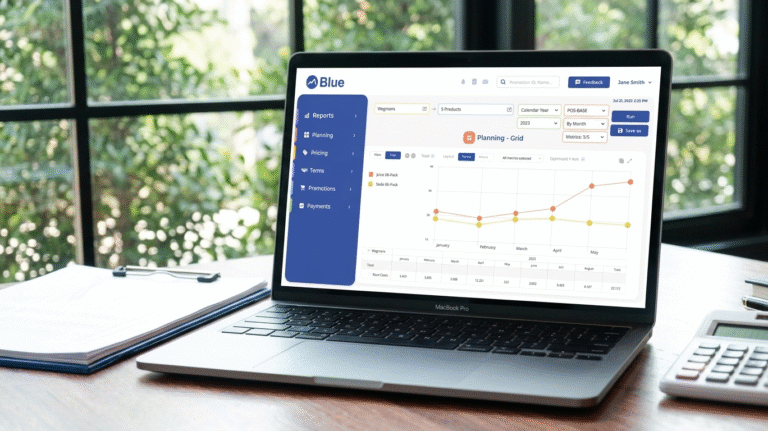
The Blue RGM Intelligence Platform supports end-to-end gross-to-net revenue management processes: Annual Operating Planning, Account Planning, and Execution. Solutions are woven together with analytics, artificial intelligence, and data management that connects teams and business systems.
We're here to help.
[email protected]