
Predicting promotional lift, the incremental sales volume generated by a trade promotion above what would have sold at everyday price, is the most technically demanding challenge in CPG/FMCG revenue management. Research by McKinsey & Company shows that 72% of US trade promotions fail to generate a profit, and a significant share of that failure is attributable to incorrect uplift assumptions at the planning stage: promotions designed around inflated lift estimates consistently underdeliver on ROI.
For CPG and FMCG brands selling through retail customers including Walmart, Kroger, Target, Costco, Amazon Fresh, Tesco, and Carrefour, accurate promotional lift prediction is the difference between trade investment that compounds and trade investment that erodes margin. TPO capabilities in Blue RGM by UpClear use AI baseline and promotion lift models trained on historical sell-out data from NielsenIQ, Circana, SPINS, or other POS to generate consistent, automated promotional lift predictions across every retail customer and SKU, enabling CPG brands to achieve 10–20% improvement in promotional ROI by concentrating spend behind promotions that demonstrably work.
Promotional lift is the incremental volume generated by a trade promotion above baseline. It refers to the additional consumer purchases attributable to the price reduction, display, or advertising investment, rather than purchases that would have occurred at everyday price regardless. Accurately predicting lift before a promotion runs requires two inputs: a reliable estimate of baseline volume (what would sell without the promotion) and a model of how much additional volume would be generated for that product through a specific promotional mechanic, a scan-back TPR, end-cap display, feature advertising, or combination.
Both inputs are technically challenging. Baseline estimation requires controlling for seasonality, competitive activity, distribution changes, and underlying demand trends. Lift modelling requires enough historical promotional data at the customer/SKU/mechanic level to identify statistically reliable patterns. According to the Promotion Optimization Institute (POI), fewer than 30% of CPG brands have the data infrastructure to produce reliable forward-looking promotional lift forecasts, leaving the majority dependent on historical averages or account manager judgment.
Four categories of methods are used by CPG/FMCG trade and/or revenue management teams to predict promotional lift, ranging from basic to advanced.
Historical averaging: the simplest approach, calculate the average lift achieved in similar promotions at the same retailer in prior years and apply it as the forecast. Directionally useful but insensitive to changes in competitive dynamics, pricing architecture, or promotional fatigue.
Syndicated data decomposition: NielsenIQ, Circana, and SPINS provide base/incremental volume decomposition in their sell-out reports, enabling brands to build historical lift rate libraries by retailer, mechanic, and price point. More accurate than simple averages but requires ongoing syndicated data investment and manual analysis to extract actionable forward-looking predictions.
Econometric modelling: statistical models built by data science teams that control for multiple demand drivers simultaneously, price elasticity, competitive promotions, distribution, seasonality, to isolate the true promotional effect. Most accurate of the manual approaches but requires specialist analytical resources most mid-market CPG brands do not have in-house.
AI base and lift forecasting: TPO capabilities in UpClear’s Blue RGM builds and maintains ML baseline and uplift models automatically, trained on historical sell-out data from NielsenIQ, Circana, SPINS, or other POS without requiring a dedicated data science team. This is the most scalable and consistent approach for CPG brands managing promotions across multiple retail customers and hundreds of SKUs.
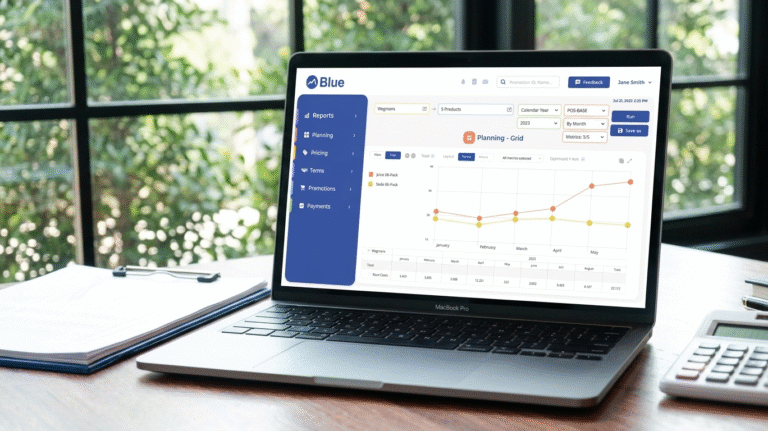
Blue RGM’s TPO capabilities automate promotional lift prediction within the same platform used for day-to-day trade promotion management (TPM), no separate analytical system required. For each customer/SKU combination, Blue RGM’s data science models establish a statistical baseline volume using historical sell-out data from NielsenIQ, Circana, SPINS, or other POS data, controlling for seasonality, trend, and distribution changes.
Uplift models then calculate the expected incremental volume from specific promotional mechanics, TPR depth, display type, feature advertising, or combination, based on the historical performance of comparable promotions at the same retailer. When an account manager builds a promotional plan in Blue RGM’s Planner module, the predicted lift and ROI for the planned scenario are displayed in real time, enabling comparison against alternatives before the plan is submitted to the retail customer. Blue RGM’s lift models update automatically as new sell-out data arrives meaning models improve continuously with every promotional event that runs.
Forecasting promotional effectiveness before committing spend requires five steps that Blue RGM by UpClear automates within its integrated TPM and TPO capabilities.
CPG/FMCG brands that activate and apply TPO tools and processes achieve a 10-20% increase in promotional ROI.
Promotional lift is the incremental sales volume a trade promotion generates above baseline, or the volume that would have sold at everyday price anyway. It’s driven by price reductions, displays, or advertising. Predicting promotional lift requires two inputs: a reliable baseline volume estimate and a model of how much additional volume a specific promotional mechanic will generate.
No. Sales lift can include growth from distribution or seasonality. Promotional lift is specific to a promotional event.
CPG/FMCG teams use four different approaches to predict predict promotional lift, ranging from basic to advanced:
1. Historical averaging (applying past lift rates)
2. Syndicated data decomposition (using NielsenIQ, Circana, or SPINS Base/incremental reports)
3. Econometric modelling (statistical models controlling for multiple demand drivers)
4. AI base and lift forecasting (building machine-learning models automatically from a brand’s own sell-out data)
Baseline estimation requires controlling for seasonality, competitive activity, distribution changes, and demand trends. However, lift modelling requires enough historical data at the customer/SKU/mechanic level to identify reliable patterns. Creating and maintaining this data infrastructure is a challenge for many CPG brands.
UpClear is a software company and maker of Blue, an intelligence platform used by Consumer Goods brands. We deliver a holistic Revenue Growth Management solution, including capabilities for TPM, TPO, IBP, and RGM. Our mission is to empower brands to maximize revenue performance and trade investment returns through intelligent, collaborative software— providing a single source of truth, streamlined automation, and actionable insights.
The Blue RGM Intelligence Platform supports end-to-end gross-to-net revenue management processes: Annual Operating Planning, Account Planning, and Execution. Solutions are woven together with analytics, artificial intelligence, and data management that connects teams and business systems.
We're here to help.
[email protected]