
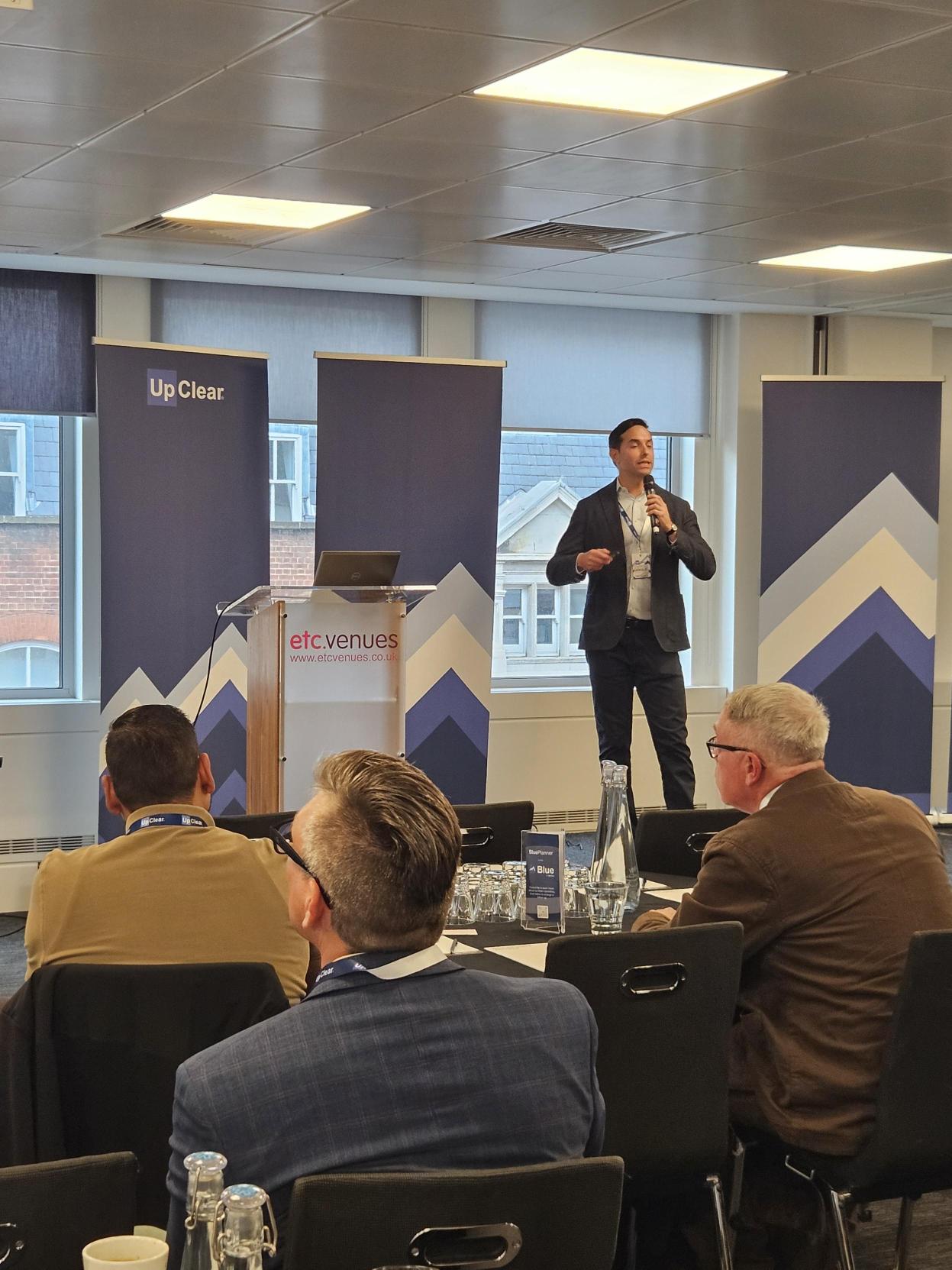
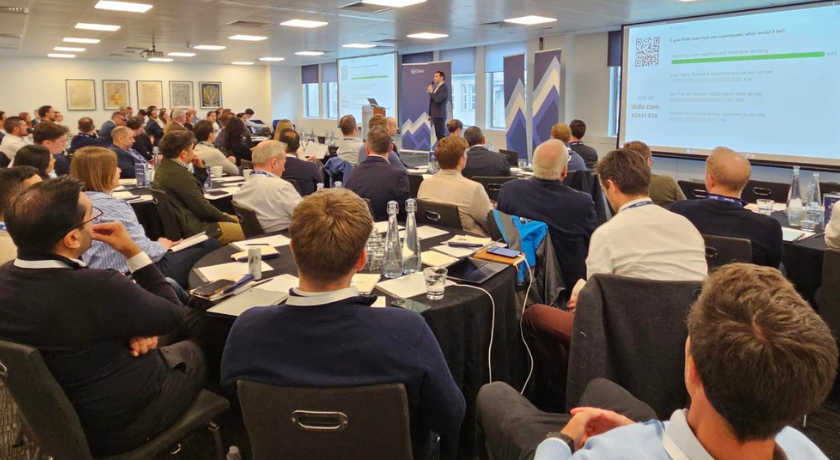
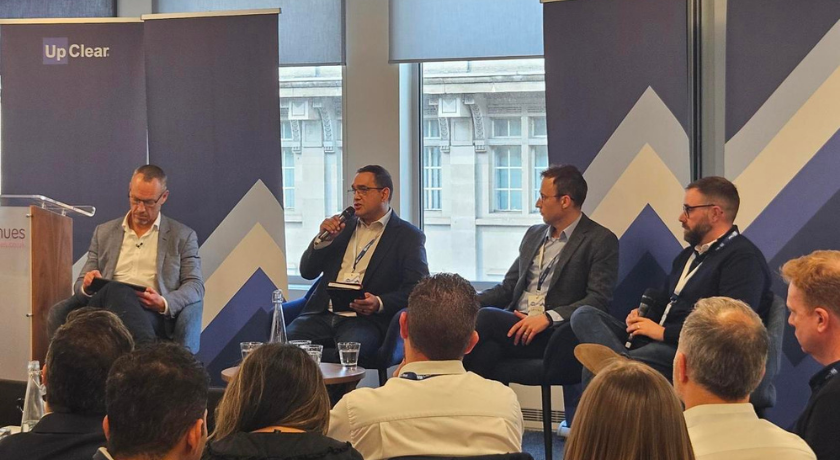
On 7 May 2026, UpClear hosted its Spring FMCG Revenue Growth Management Summit in the City of London. Commercial, finance and RGM leaders from global and UK FMCG brands joined for an afternoon of insights and learnings from industry guest presenters, expert-led discussions, and peer networking.
The afternoon unfolded against a backdrop of significant market headwinds: private label volume share in major European markets recently hitting an all-time high, only 17 of the 100 largest CPG brands growing volumes in 2025, and geopolitical volatility continuing to complicate markets and commercial planning. The conference consisted of four sessions: two keynotes from Simon-Kucher and Bain & Company, a fireside chat with The Shopper Group, and a panel discussion with revenue management leaders from Twinings, Inspired Pet Nutrition, and The Compleat Food Group.
Andreas von der Gathen, Senior Partner — Simon-Kucher
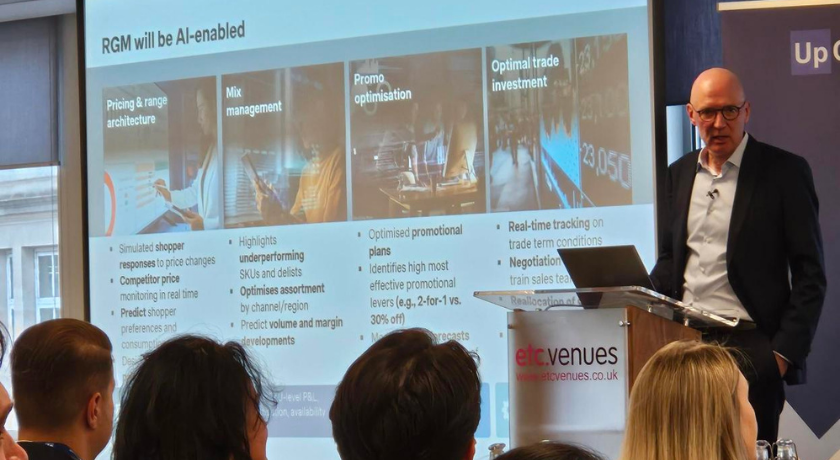
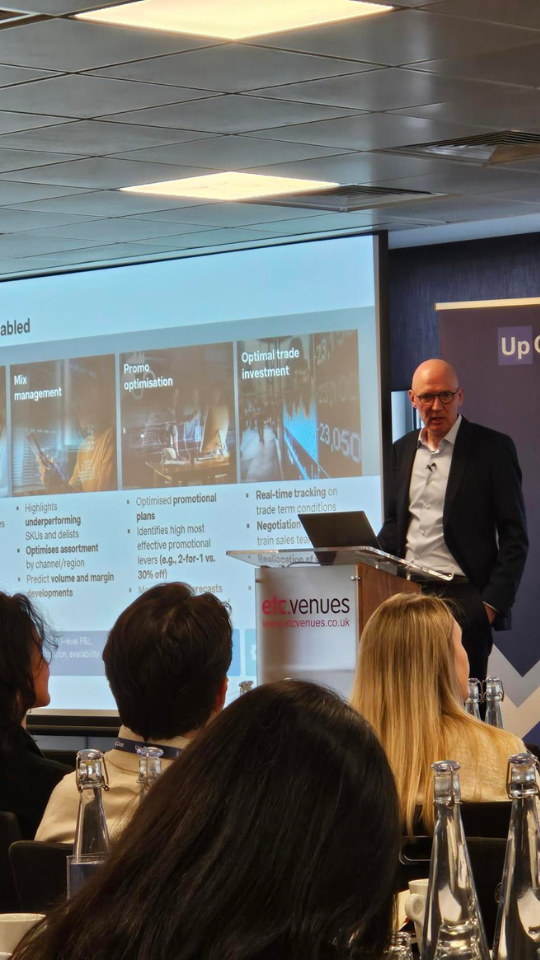
Andreas opened by challenging the room’s appetite for AI-driven margin projections, arguing that RGM 3.0 — a genuinely cross-functional, AI-enabled commercial growth model — remains aspirational for most organisations. Survey data from roughly 100 UK and European companies painted a candid picture: most RGM teams still rely primarily on Excel and basic visualisation tools, only 30% of companies report strong cross-functional coordination, and trade terms — the largest investment on many P&Ls — are frequently still managed as a sales issue rather than an RGM one.
His core argument was that transformation fails when organisations over-index on technology. Tools can deliver data and analytics, but the real gap is converting insights into decisions and decisions into execution. The disciplines that actually matter — purpose, process, and people — are harder to solve than a systems deployment.
Collaboration and human decision making are the critical enablers. He stressed the importance of ensuring organizations have quality data to harness, he expressed a strong bias to off-the-shelf technology solutions and that RGM or commercial technology implementation must be strategy-led. For organisations new to RGM, the message was to start small and work in sprints, building capability along the journey.
Andreas closed by stressing the importance of spending the majority of their transformation effort on people and behaviour. Effective change management should be the focus, ensuring strong collaboration and human decision-making to drive the success of RGM in the future.
Nick Widdowson, shopperFIRST · Adrian Baker, The Shopper Group
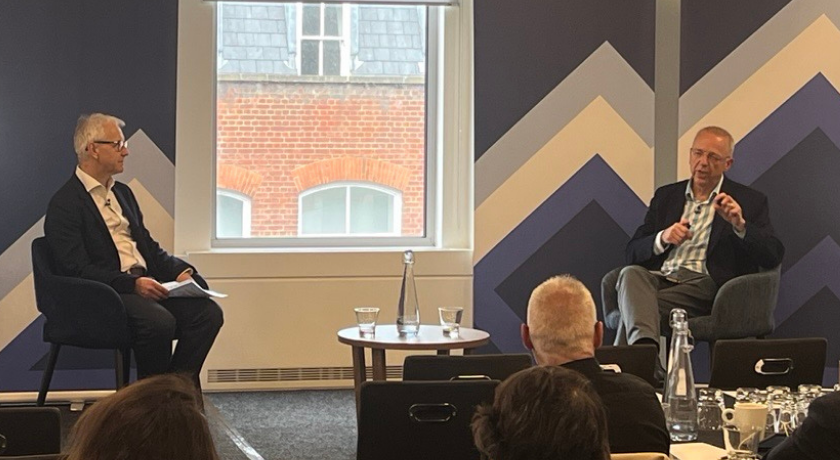
A quick show of hands at the start of the session confirmed the room’s reality: nearly everyone uses retail media, but almost no one feels confident measuring its ROI or comparing performance across touchpoints. Nick traced the idea of the store as a media channel back over two decades, noting the scale has changed dramatically. Retailers see it as high‑margin income, and brands see it as a new way to influence shoppers. Tesco’s claim that retail media would surpass broadcast TV in reach was offered as a signal of where budgets are heading; the traditional 60/40 above/below-the-line split is likely to shift materially in retail media’s favour.
However, what’s key to this shift is understanding campaign performance and optimizing your budget accordingly. As many brands find, retailers will always say “everything works.” The real skill is operational grip: knowing what actually works, what doesn’t, and learning continuously.
That’s why it’s worthwhile to invest in independent measurement. Retailer post-campaign data is useful but not impartial — retailers won’t tell you their touchpoints don’t work. Nick’s advice: supplement retailer reporting with independent evaluation, always measure incrementality rather than ROAS, and build toward a proprietary database of what works under what conditions.
A global beer brand working with The Shopper Group since 2017 doubled its retail media ROI over four years simply by doing more of what the data showed worked, learning and adjusting continuously and by walking into retailer JBP conversations with facts rather than assumptions.
The discipline required is operational and granularity is required. Know your budget, know your spend by touchpoint and shopper journey stage, and know your results — independently verified. Once you have enough data, you can start forecasting what will work before you collaborate with retailers.
Julian Davies (facilitator) · Tino De Oliveira, The Compleat Food Group · Dmytro Bench, Twinings · Craig Bosworth, Inspired Pet Nutrition
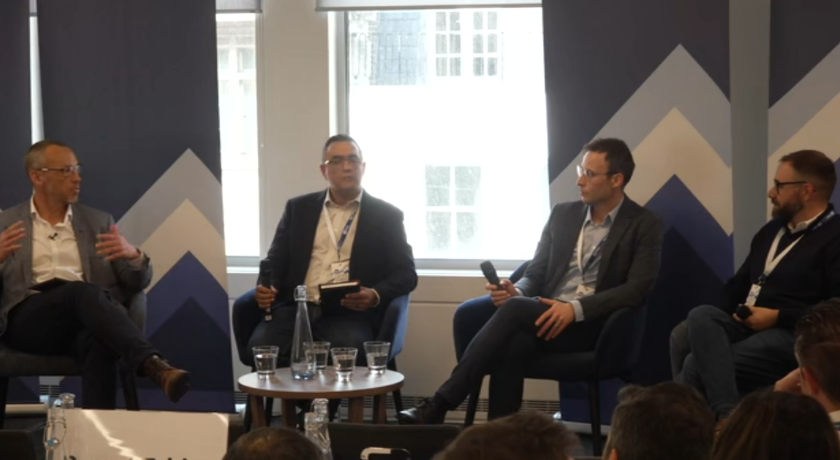
The panel opened with an honest framing: joint value creation sits somewhere between aspiration and reality. Tino opened by sharing his view that true joint value creation requires collaboration to unlock and deliver incremental value for the shopper. Unless the output is incremental and benefits all, it isn’t sustainable joint value creation.In fact, he claimed that JBPs just result in money redistribution between P&Ls.
Dymtro added the importance of long-term view and that ultimately it needs to positively influence the shopper and the category. Craig added the importance of relationship management and strategic long term customer management perspective. He shared that by continuing to invest in a specific retailer while competitors divested, Inspired Pet Nutrition secured significant incremental space in every store — worth £ millions in incremental margin — that a purely data-driven customer prioritisation model would have missed.
Supply chain integration and collaboration was one example of success, reducing stock holding and driving on shelf availability and reducing waste. On promotions that actually work for both sides: Craig’s team has secured gondola ends at full price for one of their leading brands, demonstrating that a strong brand drives category value without a discount mechanic. Tino described a cross-brand occasion based promotional activity at another leading retailer — linking five brands that delivered 16x uplift, recruited 40% more shoppers, and attracted a younger demographic that had been specifically targeted by the retailer. The pre-condition in both cases was defining clear success criteria upfront, not just financial hurdle rates.
On metrics, Craig described a balanced scorecard — 50% financial, 20% EPOS volume, 30% shopper metrics — that enables a more substantive retailer conversation than margin percentage alone. Dmytro raised the lense of using promotions to recruit and not just reward. He also highlighted the break though value of understanding feature versus shelf promotion analysis using proper data and how being transparent with retailers opened up collaborative conversation.
Looking ahead, the panel saw a shift towards fewer, bigger, more strategic bets, grounded in clearer science and objective benchmarks rather than gut feel. They talked about a focus on creating new value through category growth rather than shifting margin. They also shared a desire for a stronger control of range, price architecture and everyday value to reduce promo dependency. Above all, they talked about pursuing deeper trust‑based retailer relationships supported by better data and emerging AI tools, enabling manufacturers and retailers to invest confidently and collaboratively for long‑term shopper and category benefit.
Sumner Makin, UK AI Lead & Partner — Bain & Company

Sumner spent 25 years in machine learning, mostly in pricing, and offered a view from inside the acceleration curve: AI capability has been doubling roughly every seven months, and that interval is now shortening to nearly have the time again to double. The shift he considers most significant is the move from AI as an answer generator to AI as an autonomous agent — capable of executing extended tasks, operating across workflows, that can learn, retain memory, optimize work flows, and increasingly influence both consumer and retailer decision-making, even acting as a proxy in commercial negotiations on the retailer side. In some cases, he noted, the counterpart in a supplier negotiation is no longer a buyer but an AI assistant optimising for the retailer’s targets.
On why implementations stall, he identified three root causes:
Sumners’ discussed how culture was often a barrier. Suboptimal ways of working may lead to siloed functions, one-size-fits all approach to AI, backward looking review bias, or accepting manual overrides without debate and explanation.
He stressed that models are not decisions and that AI can help elevate the role and contribution made by humans. Machine learning can handle the analysis, while the humans make the decisions, orchestrate all the elements, own and deliver the communication and manage both trust and ethics. Humans will be managing crises, the exceptions, and issues and challenges that arise. That human judgement remains essential.
His most pointed message: RGM teams should claim ownership of AI within the commercial function rather than cede it to IT. They should secure board‑level sponsorship, pre‑allocate decision rights so models can act without waiting for committees, and invest in talent and operating‑model design with the same seriousness as technology.
He suggested a one‑to‑three‑year horizon for meaningful agentic AI adoption in CPG commercial functions, with acceleration beyond that.
He closed by emphasizing that this is about effectiveness, not efficiency: the prize is not replacing roles or cutting costs, but enabling teams to achieve more, more successfully, with the same resources.
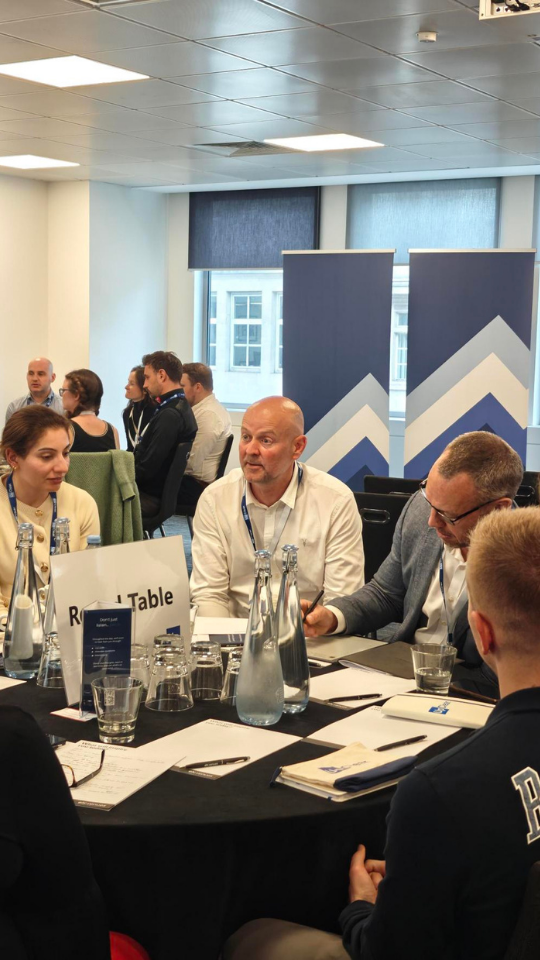
To close out the afternoon, attendees participated in facilitated roundtable discussions. They discussed themes they voted on, sharing insights, experiences and learnings. Finally, the day was rounded out with drinks to fuel continued discussions and connections.
Are you interested in a clear, focused overview of how FMCG/CPG are actually tackling RGM? We’re creating new industry research to benchmark how FMCG/CPG companies manage Revenue Growth Management practices. To create the benchmark, however, we need your input! By taking part, you’ll get early access to insights that help you: a) See how your RGM setup compares to peers, b) Understand trends in pricing, promotions, and trade investment, c) Identify capability gaps for 2026/2027 planning, d) Learn which tools, analytics, and KPIs are becoming standard, and e) See where other companies are investing next.
The survey takes 8–10 minutes, and all responses are anonymous unless you decide to share your contact information with us.
We’re already hard a work planning 2026 events. Check out the line-up here!
UpClear is a software company and maker of Blue, an intelligence platform used by Consumer Goods brands. We deliver a holistic Revenue Growth Management solution, including capabilities for TPM, TPO, IBP, and RGM. Our mission is to empower brands to maximize revenue performance and trade investment returns through intelligent, collaborative software— providing a single source of truth, streamlined automation, and actionable insights.
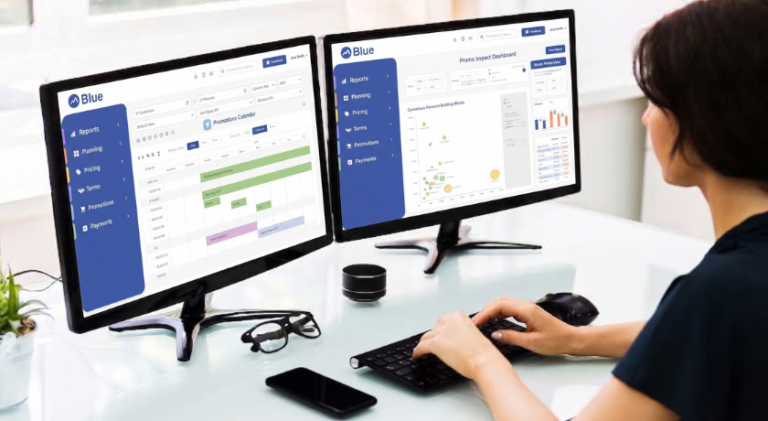
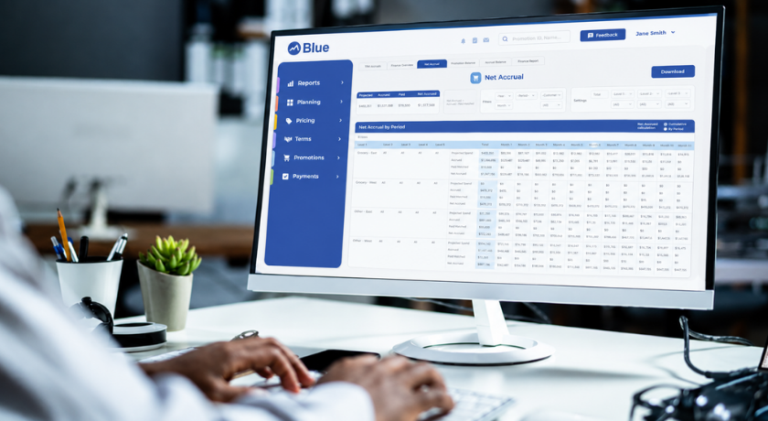
The Blue RGM Intelligence Platform supports end-to-end gross-to-net revenue management processes: Annual Operating Planning, Account Planning, and Execution. Solutions are woven together with analytics, artificial intelligence, and data management that connects teams and business systems.

We're here to help.
[email protected]