
At our inaugural CPG Data Summit on May 13th, 2026, we welcomed sales operations, trade marketing, analytics, and data professionals from across the country to our NYC office. Building on the momentum of our Deduction and RGM Summits, this event turned the lens on data itself — the crucial layer underlying everything from trade planning to RGM.
Across a full day of sessions and roundtables, practitioners and experts tackled the real-world challenges of data quality, integration, governance, and the emerging role of AI in CPG commercial operations.
We gathered some top takeaways from the conversations, case studies, and debates that took place over the course of the event.
Across every session, one theme returned with striking consistency: most data problems in CPG commercial operations are not technical failures — they’re structural ones. Bad master data, unclear ownership, and the absence of governance frameworks were cited as the root cause of everything from ROI analysis gaps to deduction disputes to forecasting disconnects.
Don Baker of The Partnering Group was direct about what he sees across his clients:
Don walked the room through the three pillars of master data readiness — the Pricing, Product, and Customer dimensions — and the specific failure modes that compound over time when governance is absent. These included: EDLP allowances hidden inside ERP pricing rather than planned and identified as customer spend, PPG structures that don’t follow TPM entry rules, check digit items shipped without billing, and customer hierarchies that don’t match external syndicated definitions.
The implication: organizations that skip governance frameworks aren’t just leaving insights on the table — they’re actively generating misleading ones.
One of the most provocative reframes of the day came from Don Baker in the opening session: the scope of RGM is wider than most organizations are treating it. With retailers now functioning as media companies, fines and fees reaching 2–3% of gross sales at some companies, and digital trade investment increasingly hard to separate from traditional trade spend, the boundary between “above” and “below” the net sales line is dissolving.
Earnings Before Interest & Taxes (EBIT) is a company’s profit from core operations before accounting for interest and tax expenses. This framing matters for data strategy: if you’re only capturing promotional spend and scan allowances in your trade system, you’re missing the full picture of what you’re investing in each customer relationship. Don also raised a pointed challenge around everyday pricing: at many of his clients, 70–80% of trade spend is going to everyday allowances — and almost nobody is running ROI analysis on it.
The room recognized this gap. As one participant noted, getting customer profitability right requires solving for the data first: “You’ve got salespeople making deals and not really knowing what they’re giving away. At the end of the day, customer profitability looks very different.”
Marine Bibal, co-founder of EasyPicky, introduced a concept that resonated strongly with attendees: the freshness gap. CPG brands are meticulous about product freshness, yet routinely monitor promotions on stale data — sometimes receiving execution information weeks after the promotion window has already closed.
Marine shared concrete examples of how execution reality diverges from plan reality: a beautifully designed snack brand Christmas display positioned at the back of the store where no shoppers could see it; a soft drink promo display placed directly next to its biggest competitor. In both cases, IPOS systems reported the display as live, and post-promo reports showed underperformance with no clear explanation.
Her prescription: make every store visit a data event. With image recognition technology working through video and full offline capability, teams can now access KPIs in real time while the field rep is still in the store — allowing discrepancies to be corrected before leaving, not just reported after the fact. She introduced four questions that her customers now embed into every promo brief:
1. Was the display actually built, and where in the store?
2. Was the promo price tag correct from day one?
3. Was the product in stock throughout the promo window?
4. What was the promo right next to mine?
Hands went up when asked who in the room had experience with in-store image recognition. Several attendees cited use cases in planogram compliance and competitive shelf auditing. Promotion compliance remains an emerging capability, but one with clear upstream implications for trade planning and ROI integrity.
UpClear’s Kurt Kaiser brought a candid vendor perspective to the day: Gartner survey data puts TPM satisfaction at troublingly low levels, and a significant contributor is the gap between what platforms can do and what they’re actually being used to do. For many organizations, the end state is a well-maintained trade system — and an equally well-maintained Excel file created to manage work-arounds.
The culprit, in many cases, is incomplete data integration. Upstream data loads (customers, products, prices, shipments) tend to be well managed. Where things fall apart is in the downstream: distributor depletion data and retail sales. When asked how many people have retail sales integrated into their trade planning, only a small minority of the room raised their hands.
Andrew Dentinger, Product Management leader at UpClear, walked through why this is hard — and how AI is starting to help. The process of taking raw retail sales data through cleansing, labeling, augmentation, and harmonization is labor-intensive, error-prone, and full of CPG-specific nuances (interpacks, combo SKUs, check digits, mismatched hierarchies) that off-the-shelf tools don’t understand.
UpClear’s approach uses layered AI techniques — from exact matching to forward/backward pass filtering to confidence scoring — to accelerate product harmonization and data preparation, while preserving a human override at every step. The modeling itself, Andrew noted, is increasingly commoditized. Copilot and similar Large Language Model (LMM) tools can run a price elasticity analysis on a clean spreadsheet in seconds. Getting to that clean spreadsheet remains the hard part.
Throughout the day, the conversation about AI kept returning to the same guardrail. Across the opening discussion, Andrew’s data readiness presentation, and Don’s closing governance session, speakers converged on a shared thesis: AI amplifies what’s already there — good or bad. It will not fix a broken process. It will not flag dirty data. It will give you a confident answer based on whatever it’s been handed.
Don drew a direct line from this to organizational behavior: when companies realize AI-driven productivity savings, they often take it as a one-time headcount reduction rather than reinvesting in the critical thinking roles that can actually capture value from it. His recommendation: reapply those savings to data and analytical functions that can put AI to work properly.
Andrew was similarly measured about the technology itself: for most CPG use cases, simple regression and statistical models that are decades old will outperform cutting-edge LLMs — because the data environments are small and bounded. “You have 104 weeks of Nielsen data to work with. You aren’t looking at sentiment analysis across billions of observations in a social media feed.”
The practical upshot, endorsed across sessions: start with governance. Get master data right. Define what you’re trying to measure and why. Then consider whether AI is the right tool for a given step in the process — and always keep a human in the loop.
Thierry Soudee — UpClear, Founder & CEO
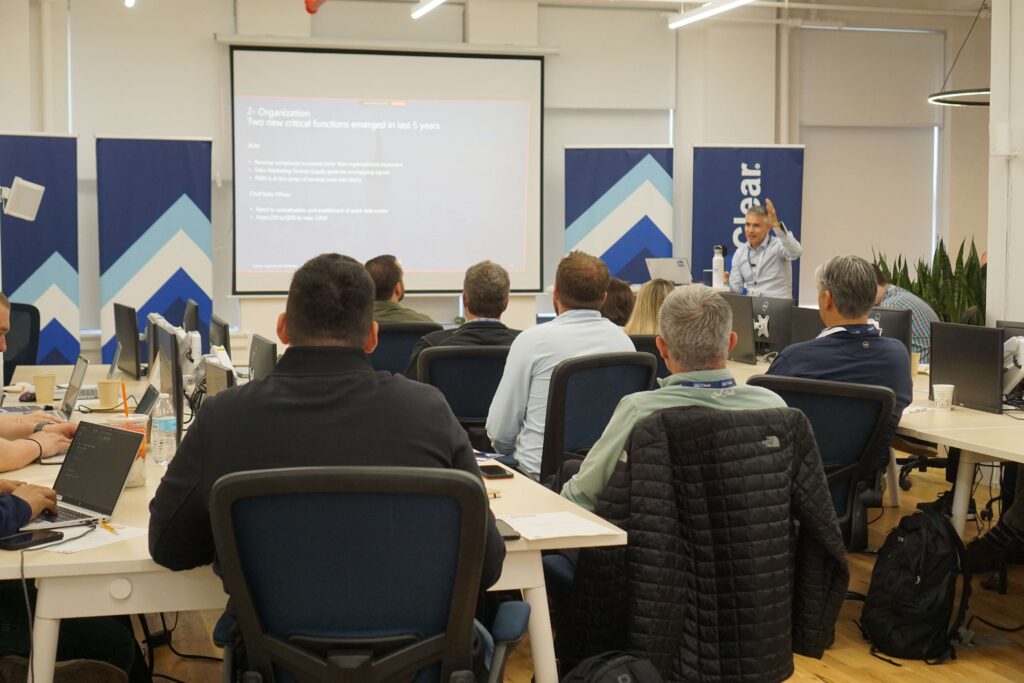
Thierry opened the day with a data-driven look at how the CDO role has evolved in CPG — from systems management to governance, data product thinking, and AI oversight. He contextualized the scale of the data explosion facing mid-market brands, highlighted the emergence of RGM as a must-have function, and set the stage for the day’s discussions around data quality, trust, and speed of decision-making.
Don Baker — The Partnering Group
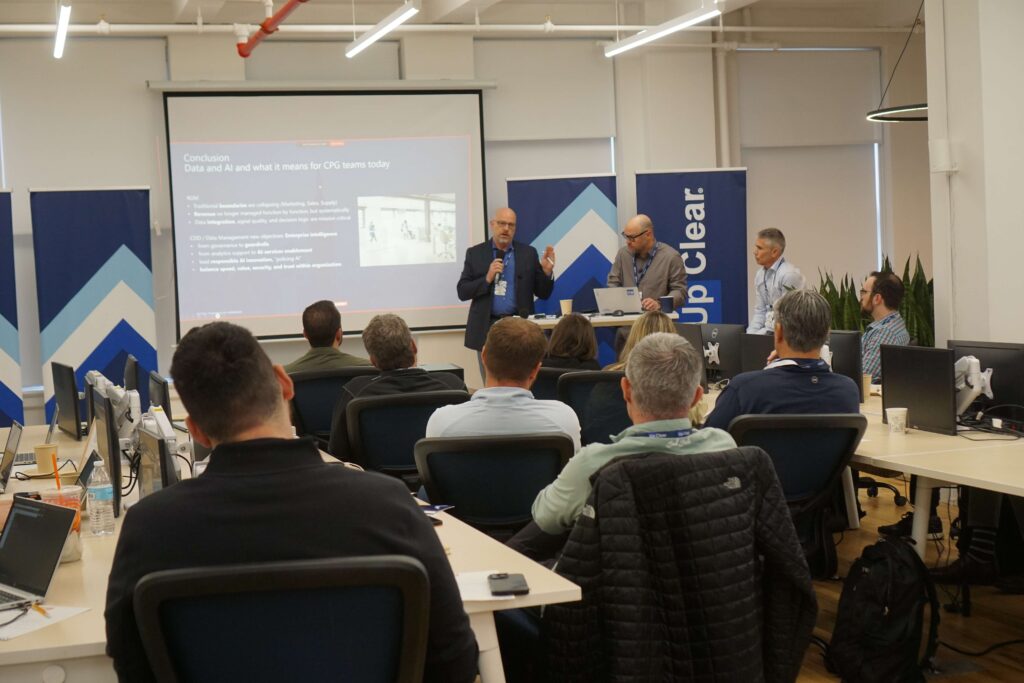
Don brought years of RGM consulting experience and a practitioner’s candor to his two sessions. In the first, he walked through the master data readiness areas of Pricing, Product, and Customer — with case studies, do’s and don’ts, and a persistent challenge to the room: get the business driver language right before the finance language, or your trade system will never serve its purpose.
Marine Bibal — EasyPicky, Co-Founder
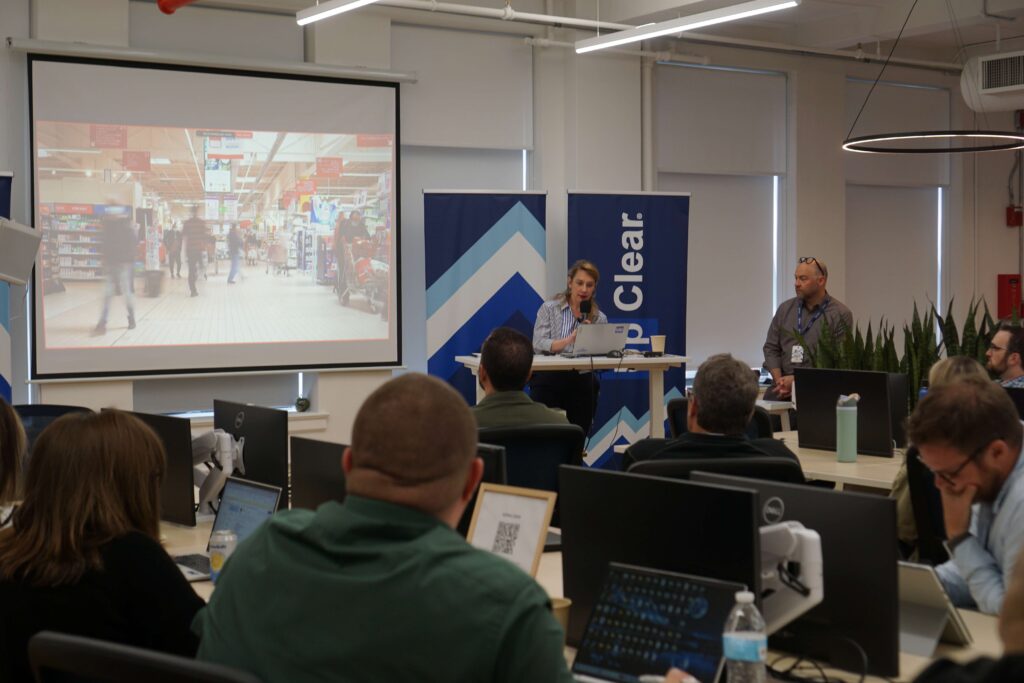
Marine introduced the concept of the ‘freshness gap’ in promo execution data — the lag between when a promotion runs and when brands receive visibility into how it actually executed at the shelf. She shared real-world examples of promotion plans that looked perfect on paper but failed in the store, and outlined a framework for embedding qualitative execution data into the promo planning process.
Andrew Dentinger — UpClear, Product Director
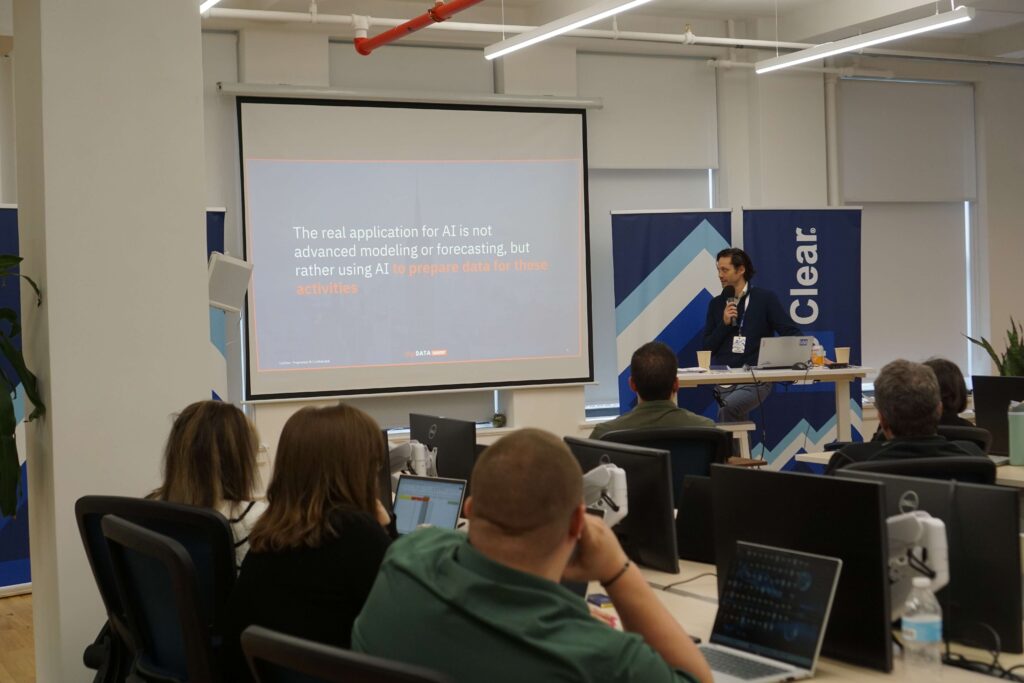
Andrew provided a grounded overview of what data readiness actually means — walking through anomaly detection, tokenization, product mapping challenges, and the role of synthetic data. He also offered a frank perspective on AI: in CPG, the value is less in advanced generative models than in using AI to cleanse, label, and prepare data for modeling — a step most organizations still do manually.
Don Baker — The Partnering Group
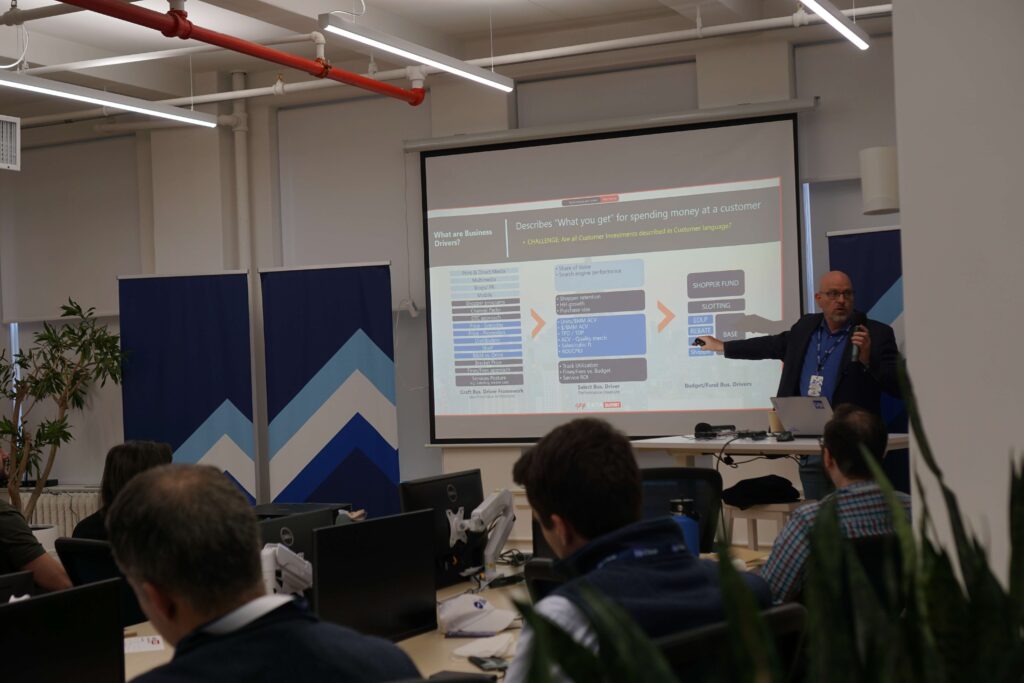
In his second session, Don connected data strategy to organizational design, governance structures, and the practical mechanics of getting started — even for small teams. He shared his own master data governance org from Sara Lee, walked through intake form-based governance as a starting point, and closed with guidance on pricing strategy in the context of current tariff and fuel cost uncertainty.